IVX Agency · computer work
Delegate knowledge work through desktop and cloud agents. The human receives results, reviews decisions, and closes the laptop.
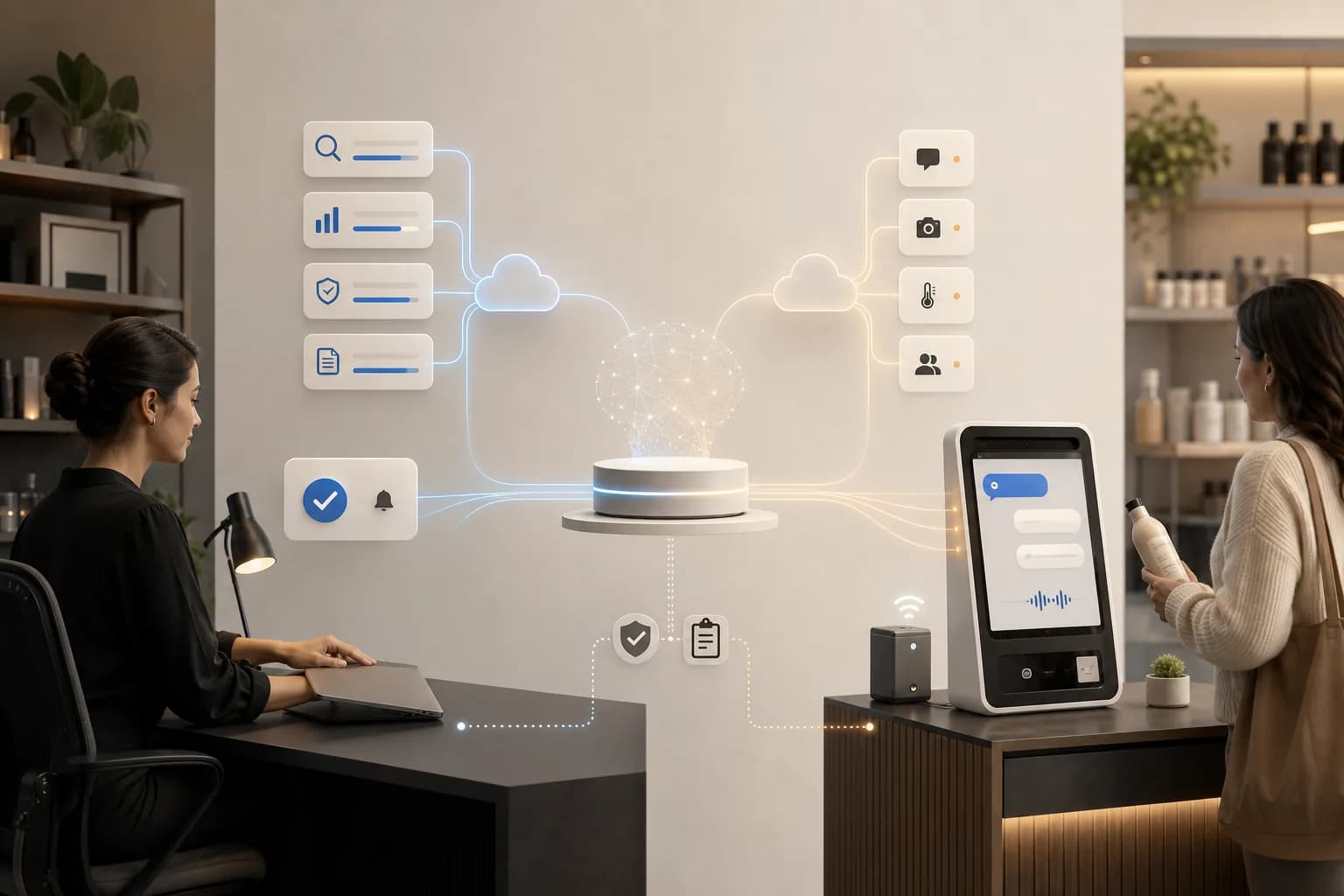
Explore IVX Agency Desktop →IVX Edge is a pilot for granting explicit, revocable agent capabilities to a supported physical endpoint — so it can observe or act locally, with cloud help, under policy.
Example: approve a venue welcome-screen update, queue it safely while offline, and retain only a scoped audit summary.
No production device package is offered today. The demo is simulated and performs no action on your device.
Delegate knowledge work through desktop and cloud agents. The human receives results, reviews decisions, and closes the laptop.
Explore IVX Agency Desktop →Grant a supported endpoint narrow capabilities so it can observe or act locally and with cloud agents under policy, confirmation, audit, and revocation.
Both are designed to use scoped identity, Memory, audit, and revocation. The Edge fleet implementation is not production-complete.
The illustration is conceptual. The semantic steps below are the product contract; the public demo covers only the simulated task and reconnect path.
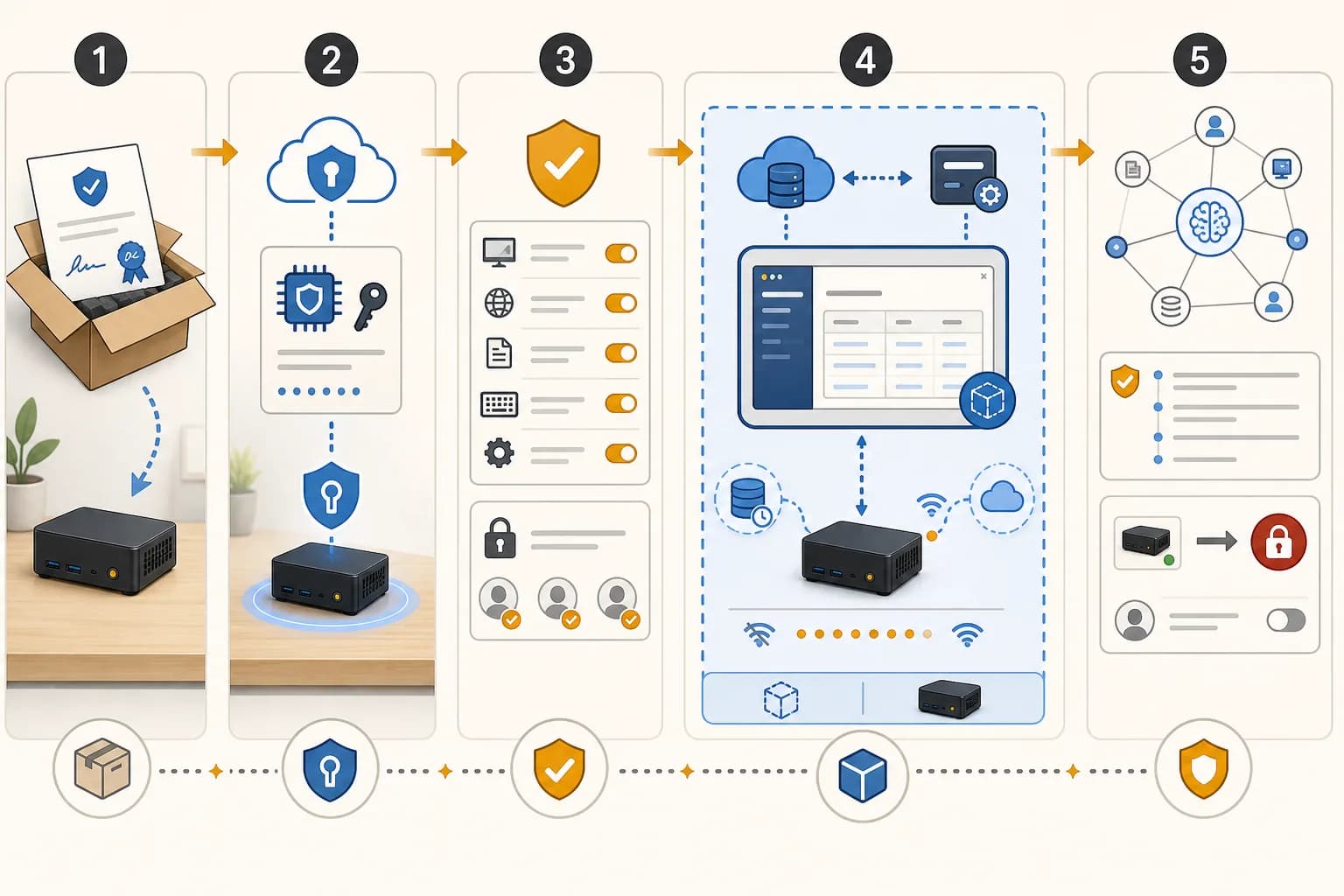
The target state is an OS-specific, signed package with checksums, SBOM, provenance, and rollback. No public device package is available yet.
A short-lived, one-time code binds a device identity to one workspace and App ID. The pilot contract requires per-device credentials and revocation.
Operators select named adapters such as screen content or a read-only sensor. Shell, root, arbitrary GPIO, camera, and microphone are not granted by default.
Cloud reasoning can request a bounded local action. Mutations wait for policy or confirmation; offline tasks retain stable IDs and reconcile once.
Minimal events can enter workspace/App/device/subject-scoped Memory under consent and retention rules. Operators can revoke the device or capability.
Every adapter is simulated. No command reaches your computer, network, camera, microphone, GPIO, printer, or physical hardware.
Choose a task to see allowlisting, offline queueing, confirmation, and idempotent completion.
A local demo summary appears only after a completed task; it is not sent to the production Memory service.
The first credible design-partner target is a 64-bit Linux x86 mini-PC driving a venue screen through screen.content.set. IVX Edge would supply the governed endpoint contract; KioskX remains the retail experience and operator product.
“Pilot candidate” is not “supported.” Hardware cells stay gated until package, board-in-loop, soak, update, rollback, and safety tests pass.
| Target | Status | Current evidence |
|---|---|---|
| Browser simulator | Available on this page | Deterministic software path only; it never controls local hardware. |
| Linux x86-64 mini-PC | Pilot candidate | Source-level runtime contract; package signing and hardware E2E remain gates. |
| Raspberry Pi 4/5, 64-bit Linux | Pilot candidate | No board-in-loop, GPIO, thermal, or long-duration evidence yet. |
| NVIDIA Jetson | Evaluation | No JetPack compatibility or GPU workload validation yet. |
| Windows / macOS computers | Use IVX Agency | IVX Edge is not packaged for these systems; IVX Agency is the desktop product. |
| Android / iOS / industrial controllers | Not supported | No package, enrollment, policy, or certification evidence. |
Expired, unsigned, replayed, cross-tenant, or ungranted commands must not execute.
Named adapters only. No arbitrary shell, root, unrestricted filesystem, or unsafe actuator bridge.
Camera, microphone, biometrics, and person-linked Memory require explicit scope, indicators, and retention.
Production requires inventory, RBAC, audit export, staged rollout, rollback, kill switch, and wipe/revoke.
No. The browser simulator and device security contract are a pilot foundation. Production availability requires signed packages, a managed enrollment service, fleet controls, supported-hardware tests, staged OTA, rollback, and independent security review.
Neither. The Router edge service is the platform network/API layer. KioskX is the separate phygital retail product. IVX Edge is the proposed governed endpoint runtime that could integrate with platform services or a KioskX deployment.
No. The pilot contract forbids arbitrary shell/root access and unsafe actuator or GPIO commands. Each action must use a bounded, allowlisted adapter; mutations require policy or confirmation. The public demo uses mocks only.
Not by default. Camera and microphone capture are outside the current simulator and require a separately approved capability, explicit scoped consent, visible indicators, retention limits, and deployment-specific legal review.
Pilot qualification starts with hardware, OS image, network conditions, physical actions, consent boundaries, and rollback requirements — before an availability date.